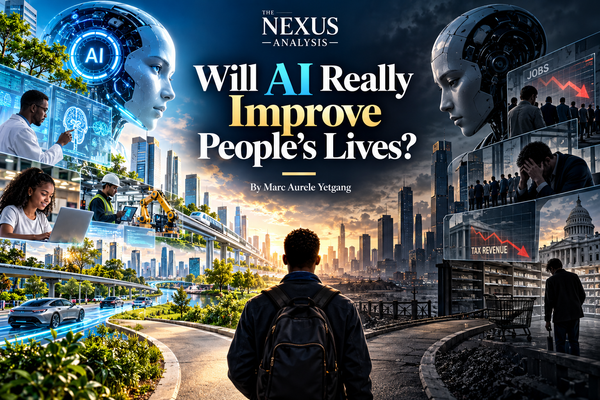
Why Developing Countries Could Benefit More From AI than Developed Countries

How Artificial Intelligence Could Reshape the Global Economic Balance
By Marc Aurele Yetgang
The Nexus Analysis | Global Economics & Artificial Intelligence
Introduction: The Unexpected Winners of the AI Revolution
The global conversation surrounding artificial intelligence has largely focused on developed economies, particularly the United States, Europe, and China.
These economies dominate technological innovation, artificial intelligence research, semiconductor development, computing infrastructure, and investment in advanced technologies.
Consequently, many assume that developed countries will naturally become the greatest beneficiaries of the artificial intelligence revolution.
But I believe this assumption deserves to be challenged.
What if the greatest economic opportunities created by artificial intelligence are not found in the countries that are already highly developed, but in countries still struggling to achieve their full productive potential?
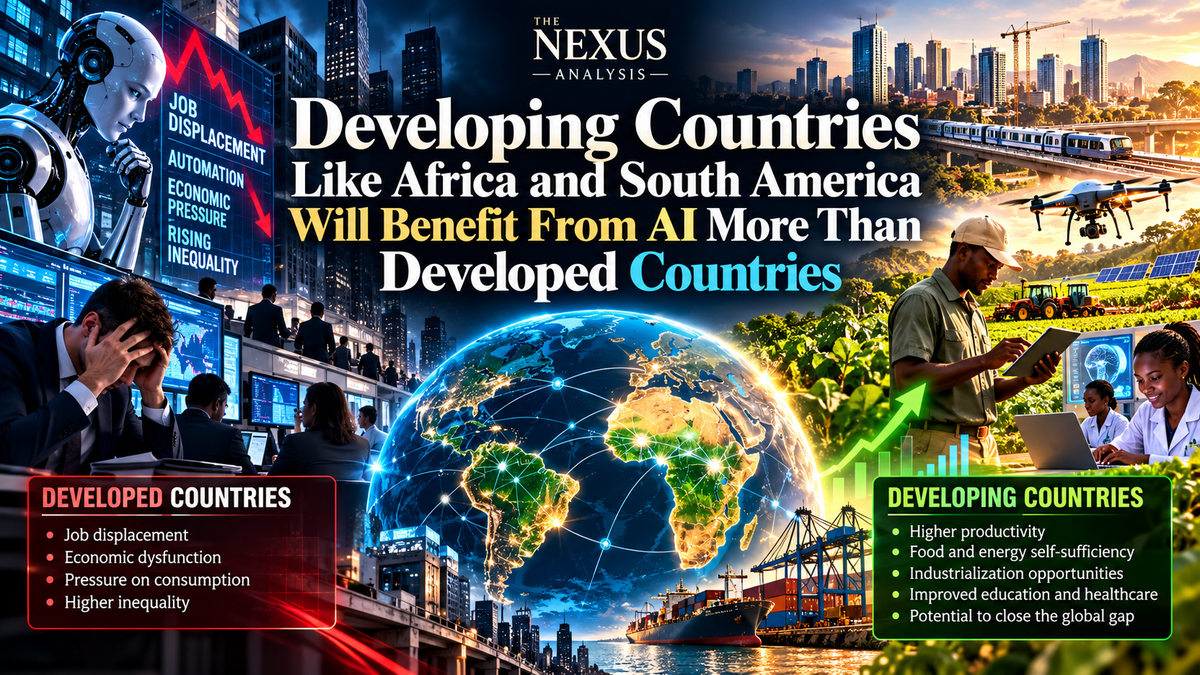
My central argument is that developing economies, particularly those in Africa and South America, could experience greater transformational benefits from artificial intelligence than developed economies.
The reason is fundamentally economic.
Developed countries already possess relatively sophisticated production systems, advanced infrastructure, high productivity, and established labor markets.
Developing countries, by contrast, often face significant structural challenges, including low productivity, insufficient industrial capacity, inadequate infrastructure, limited access to technology, and dependence on imported goods.
Artificial intelligence, robotics, and intelligent automation could help address many of these challenges.
The result could be a historic opportunity for developing countries to accelerate economic growth and narrow the development gap with advanced economies.
1. Developed Countries: The Challenge of Replacing Existing Labor
To understand this argument, we must first examine how artificial intelligence could affect advanced economies.
Consider the United States.
The American economy is highly developed, predominantly service-oriented, and deeply integrated with digital technologies.
Millions of people work in finance, administration, transportation, healthcare, education, information technology, professional services, and other industries increasingly exposed to artificial intelligence.
As AI becomes more capable, companies may automate a growing number of tasks currently performed by human workers.
From a business perspective, this transformation offers substantial opportunities.
Companies could reduce operating costs, improve efficiency, accelerate production, and increase profitability.
However, the broader economic consequences may be more complicated.
Workers are not only factors of production.
They are also consumers.
Their employment income allows them to purchase goods and services, supporting the revenues of businesses throughout the economy.
If artificial intelligence replaces significant numbers of workers faster than new employment opportunities emerge, household purchasing power could deteriorate.
This creates a potential economic contradiction:
Companies may become more productive while the purchasing power of the population becomes increasingly vulnerable.
Such an outcome is not inevitable. Technological progress can create new jobs, lower prices, increase investment, and generate new industries.
Nevertheless, if the transition is poorly managed, advanced economies could face serious challenges involving unemployment, inequality, consumer demand, and income distribution.
2. Developing Countries: The Challenge Is Often Insufficient Production
Now consider the economic situation of many countries in Africa and South America.
Their principal challenge is frequently different.
Rather than possessing highly productive economies in which automation primarily replaces established jobs, many developing countries still struggle to generate sufficient productive capacity.
Agricultural productivity remains low in numerous regions.
Manufacturing industries often lack modern machinery and technological infrastructure.
Electricity shortages, transportation costs, limited financing, and insufficient technical expertise constrain business expansion.
Many countries also depend heavily on imports for essential manufactured goods, machinery, energy products, or particular food commodities.
This means that artificial intelligence could serve a fundamentally different economic purpose.
Instead of primarily replacing existing production systems, AI could help developing countries build and expand productive capacity that is currently insufficient.
This distinction is essential.
In advanced economies, AI may frequently be introduced to make already productive systems more efficient.
In developing economies, AI could help overcome structural barriers that have prevented productive systems from reaching their potential.
3. Africa: Artificial Intelligence as an Instrument of Economic Transformation
Africa presents a particularly important case.
The continent has a large and growing population, substantial natural resources, expanding consumer markets, and significant opportunities for agricultural and industrial development.
However, many African economies continue to face challenges related to productivity, industrialization, infrastructure, and access to capital.
Artificial intelligence could help address these problems.
Agriculture and Food Production
AI-assisted agricultural systems could help farmers improve crop management, identify diseases, optimize irrigation, forecast yields, and reduce waste.
When combined with mechanization and modern agricultural infrastructure, these technologies could contribute to greater food production and lower costs.
This could help countries strengthen food security and reduce dependence on certain agricultural imports.
Industrialization and Manufacturing
Robotics and intelligent production systems could help African manufacturers increase output, improve quality, and develop more competitive industries.
Rather than relying exclusively on traditional labor-intensive industrialization, countries could adopt modern production technologies where economically appropriate.
Education and Human Capital
Artificial intelligence could expand access to educational resources, personalized tutoring, technical training, and professional knowledge.
This is particularly important in economies where shortages of qualified teachers, specialized professionals, and educational infrastructure constrain human capital development.
Healthcare
AI-assisted medical technologies could support diagnosis, administrative efficiency, medical training, and healthcare delivery.
In underserved regions, these tools could help extend the reach of existing healthcare professionals.
However, these benefits will depend on reliable infrastructure, professional oversight, affordability, and appropriate regulation.
The broader opportunity is clear:
Africa could use artificial intelligence not merely to automate economic activity, but to develop economic capabilities that remain insufficiently available.
4. South America: A Major Opportunity for Productivity Growth
South America could also become an important beneficiary of artificial intelligence.
Countries such as Brazil, Argentina, Chile, Colombia, and Peru possess substantial agricultural, mining, energy, industrial, and service-sector capabilities.
Yet many economies in the region continue to face challenges involving productivity growth, inequality, infrastructure, informality, and industrial competitiveness.
Artificial intelligence could contribute to improvements across several sectors.
In agriculture, AI could support precision farming, resource management, and supply-chain optimization.
In mining, intelligent systems could improve exploration, equipment maintenance, safety, and operational efficiency.
In manufacturing, automation could help businesses improve quality and productivity.
In energy, AI could support electricity management, renewable energy integration, and infrastructure maintenance.
In education and healthcare, AI could improve access to services and help address shortages of specialized expertise.
The opportunity for South America is therefore not limited to developing technology companies.
AI could strengthen the productivity of existing industries while helping create new sources of economic value.
Nevertheless, the region's countries differ considerably in their economic structures and technological capabilities. The benefits will depend on national policies, investment, workforce development, and access to technology.
5. The Economic Paradox: Automation Versus Development
This brings us to the central hypothesis.
Artificial intelligence could produce different economic outcomes depending on the level of development of the economy adopting it.
In highly developed economies, AI may increasingly substitute for existing human labor and established business functions.
In developing economies, AI may offer opportunities to overcome shortages of productive capacity, specialized knowledge, and modern infrastructure.
We can summarize this distinction:
Developed economies: AI as a force of substitution and productivity improvement.
Developing economies: AI as a force of productive expansion and structural transformation.
Both types of economies can experience both effects.
However, the relative importance of each effect may differ substantially.
For a country already operating with advanced productive infrastructure, the additional benefits of automation must be weighed against possible labor-market disruption.
For a country struggling with low productivity, AI could help expand production and improve access to essential goods and services.
This leads to an important proposition:
The economic value of AI should be evaluated not only according to the technological capabilities it creates, but also according to the economic problems it helps a country solve.
6. Could AI Reduce the Global Development Gap?
One of the most important potential consequences of this transformation concerns the global distribution of economic power.
For decades, developing countries have struggled to narrow the productivity and income gaps separating them from advanced economies.
Industrialization requires substantial investment, infrastructure, technical expertise, and institutional capacity.
Artificial intelligence could reduce some of these barriers.
AI-powered tools may make certain forms of knowledge, technical assistance, software development, and operational optimization more accessible.
When combined with investment in energy, machinery, education, and infrastructure, AI could help developing countries accelerate productivity growth.
This creates the possibility of economic convergence.
However, there is an important risk.
If developing countries remain dependent on foreign AI infrastructure, imported technologies, and external providers, a substantial portion of the economic value generated could flow toward companies and countries that control those technologies.
AI could therefore widen the global development gap rather than reduce it.
The outcome will depend on whether developing countries develop the capacity to use AI strategically, build complementary infrastructure, strengthen domestic industries, and capture a meaningful share of the value created.
7. A New Economic Strategy for Developing Countries
If developing countries want to become major beneficiaries of artificial intelligence, they must approach it as more than a technological trend.
They need national strategies connecting AI to their most pressing economic challenges.
For African countries, priorities could include agricultural productivity, food security, energy infrastructure, industrialization, education, healthcare, and domestic entrepreneurship.
For South American countries, priorities could include industrial modernization, agricultural innovation, mining productivity, energy development, logistics, and the expansion of technology-intensive industries.
The objective should not simply be to adopt artificial intelligence because developed countries are adopting it.
It should be to identify the economic constraints AI can realistically help overcome.
Countries must also invest in electricity, internet connectivity, education, financing, institutional capacity, and workforce development.
Without these foundations, the potential benefits of AI may remain concentrated among a small number of businesses and urban populations.
The greatest beneficiaries of the AI revolution will not necessarily be the countries that adopt the most AI systems, but those that translate AI adoption into sustainable improvements in productivity, living standards, and economic opportunity.
Conclusion: The AI Revolution Could Change the Global Economic Hierarchy
Artificial intelligence may become one of the most powerful forces shaping the global economy during the twenty-first century.
But its benefits will not necessarily follow the existing distribution of economic wealth.
Developed countries possess enormous advantages in research, capital, infrastructure, and technological innovation.
They are therefore well positioned to capture substantial economic gains from AI.
Yet they may also face difficult transitions involving employment, income distribution, and the restructuring of established industries.
Developing countries, particularly in Africa and South America, face a different opportunity.
They could use artificial intelligence, robotics, and intelligent automation to address longstanding productivity challenges, expand domestic production, improve essential services, and accelerate economic development.
This does not guarantee that developing countries will outperform advanced economies.
But it suggests that the relative transformational value of AI could be greater in economies where productive capacity remains substantially below its potential.
The AI revolution could therefore become an opportunity to reshape the global economic balance.
My central conclusion is this:
Artificial intelligence may be most transformative not where economies are already highly productive, but where the need for productivity growth is greatest.
If developing countries recognize this opportunity and implement the right economic strategies, AI could become a historic instrument for narrowing the global development gap.
The future winners of the AI revolution may not simply be the countries that invent the technology, but also those that use it to transform their economies.
Marc Aurele Yetgang
The Nexus Analysis
Independent Perspectives on Economics, Artificial Intelligence, and Global Transformation