Could AI Companies Lose Stock Market Value After Republicans Lose Congress

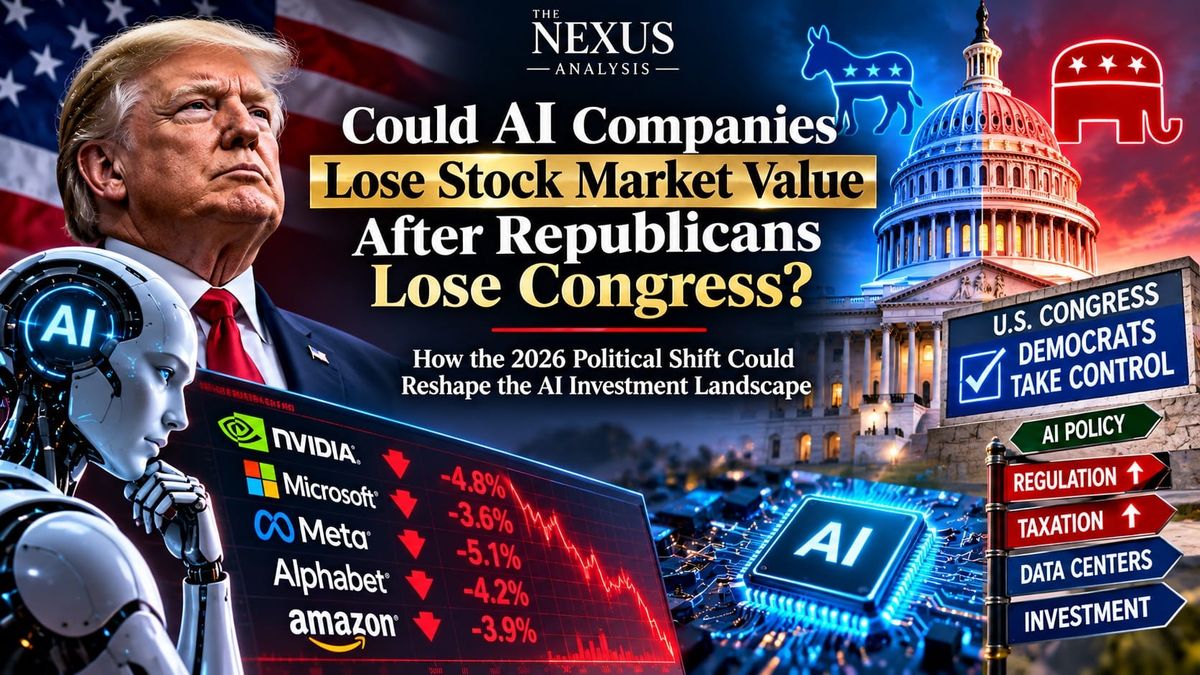
How the 2026 Midterm Elections Could Reshape AI Investment and Market Valuations
By Marc Aurele Yetgang
The Nexus Analysis | Financial Markets, Artificial Intelligence & U.S. Politics
Introduction: A New Political Risk for AI Investors
Artificial intelligence has become one of the most important investment themes in the American stock market. Companies developing AI models, semiconductors, cloud infrastructure, and data centers have attracted enormous investor attention.
But the future valuation of these companies may depend on more than technological innovation, productivity, revenue growth, and profitability.
It may also depend on politics.
Following the November 3, 2026 midterm elections, Democrats are projected to take control of both chambers of Congress, ending Republican legislative majorities and creating a new political environment for President Donald Trump.
This development raises an important question:
Could the loss of Republican control of Congress reduce investor confidence in AI companies and put downward pressure on their stock market valuations?
I believe this possibility deserves serious consideration.
My central argument is that artificial intelligence has become so economically and strategically important that changes in political power can influence the future profitability, investment expectations, and valuations of companies operating within the AI industry.
1. Donald Trump and the Expansion of Artificial Intelligence
President Donald Trump has positioned artificial intelligence as a major component of American technological leadership, economic competitiveness, and national security.
His administration has emphasized accelerating AI innovation, reducing regulatory barriers, expanding data-center infrastructure, and supporting American leadership in global AI markets.
This political environment has been favorable to companies seeking to expand AI-related investment.
For investors, government policy matters because it influences the conditions under which businesses operate.
A supportive regulatory environment can reduce compliance costs, accelerate infrastructure development, and improve expectations about future profitability.
Consequently, political support for AI can become an important factor in stock market valuation.
However, the president does not exercise unlimited control over economic policy.
Congress influences legislation, federal spending, taxation, and oversight.
A change in congressional control can therefore alter the political conditions surrounding the AI industry even when the president remains strongly supportive of technological development.
2. Why Democratic Control Could Affect AI Valuations
With Democrats preparing to assume control of both chambers, AI companies could face greater legislative scrutiny.
Possible areas of policy disagreement include AI safety, data privacy, consumer protection, employment displacement, competition, energy consumption, and the environmental consequences of expanding data centers.
For investors, the economic significance lies in how these policies could affect future corporate earnings.
Stricter requirements could increase compliance costs.
Additional oversight could slow the deployment of certain AI systems.
Changes to infrastructure permitting or energy policy could affect the speed and cost of constructing data centers.
Greater scrutiny of dominant technology companies could also influence their business strategies and competitive advantages.
These developments would not necessarily damage every AI company.
Some regulations could improve public trust, reduce legal uncertainty, and create more predictable operating conditions.
Nevertheless, if investors expect a less favorable policy environment to reduce future profitability, they may revise their valuations downward.
3. Political Risk as a Variable in Fundamental Analysis
In my previous analysis, How AI Is Reshaping Investment and Stock Markets, I argued that artificial intelligence will become a major variable in fundamental analysis.
Investors will increasingly need to evaluate how AI affects a company's productivity, costs, revenues, competitive advantages, and future cash flows.
But the relationship also works in the opposite direction.
Companies developing and commercializing AI are themselves exposed to political and regulatory decisions.
This means the valuation of an AI company should consider not only its technological capabilities but also the political environment in which it operates.
We can summarize the mechanism:
Political Change → Regulatory Expectations → Expected Costs and Growth → Future Cash Flows and Risk → Stock Market Valuation
A company may possess extraordinary technology and strong growth prospects while experiencing a decline in market valuation if investors believe its future operating environment has become less favorable.
The important distinction is between the economic value of the technology and the market value of the company producing it.
Artificial intelligence can continue advancing even while AI-related stocks experience significant corrections.
4. The Risk of a Market Revaluation
One of the characteristics of rapidly expanding technological industries is that investors often assign substantial value to expected future growth.
AI-related companies may trade at valuations reflecting expectations of expanding demand, high profitability, and sustained investment in computing infrastructure.
When these expectations are optimistic, even relatively small changes in perceived risk can have important consequences.
Political uncertainty could become one of those changes.
If investors begin anticipating slower infrastructure expansion, higher compliance costs, or restrictions affecting AI deployment, they may reduce the valuations they are willing to assign to certain companies.
This could affect semiconductor manufacturers, cloud infrastructure providers, data-center operators, AI developers, and other businesses whose expected growth depends heavily on the expansion of artificial intelligence.
However, not every company would experience the same consequences.
Businesses with strong earnings, diversified revenues, durable competitive advantages, and sufficient financial resources may be better positioned to absorb regulatory changes.
Companies with high debt, weak cash flow, or valuations dependent on extremely optimistic growth assumptions may be more vulnerable.
5. The Election Is Not the Only Risk Facing AI Stocks
It would be economically misleading to attribute every decline in AI-related stocks to the change in congressional control.
The AI industry also faces fundamental financial questions.
Are companies generating sufficient revenue from AI to justify their infrastructure spending?
Will demand for computing capacity continue expanding at the pace investors expect?
Can AI developers achieve sustainable profitability?
Will competition reduce the prices of AI services?
Could rising electricity costs, financing costs, and capital expenditures reduce future returns?
These questions matter independently of politics.
A market correction could result from a combination of changing growth expectations, financing conditions, competitive pressures, and regulatory uncertainty.
Therefore, the election should be understood as a potential additional source of risk rather than the sole explanation for movements in AI stock prices.
6. Could Political Gridlock Protect AI Companies?
There is another possibility investors should consider.
Democratic control of Congress does not automatically mean that restrictive AI legislation will become law.
President Trump retains executive authority and the ability to veto legislation, subject to constitutional limits.
A divided political system could produce legislative gridlock, making major regulatory changes difficult to implement.
Furthermore, support for American technological competitiveness exists across party lines, even when Republicans and Democrats disagree about the appropriate level of regulation.
The outcome could therefore be more complicated than a simple relationship between Democratic control and falling AI stock prices.
Some companies could face additional uncertainty, while others could benefit from clearer standards or a more stable regulatory framework.
The market impact will depend on actual policy proposals, their probability of becoming law, and their expected economic consequences.
7. What Should AI Investors Watch?
The political transformation in Washington introduces another dimension into AI investment analysis.
Investors should pay attention to the direction of congressional AI legislation, data-center permitting, energy policy, federal procurement, taxation, competition policy, and regulatory oversight.
They should also distinguish between companies whose valuations are primarily supported by current earnings and those whose valuations depend heavily on future expectations.
A company with strong cash flows may withstand political uncertainty better than a business whose financial model requires uninterrupted investment growth and favorable financing conditions.
The central question is not simply whether Democrats or Republicans control Congress.
It is:
How will changes in political power affect the future economic value that AI companies can generate and retain?
Conclusion: AI Stocks Are Becoming Increasingly Exposed to Political Risk
The artificial intelligence revolution is not taking place outside the political system.
It is increasingly connected to government policy, national competitiveness, infrastructure development, energy production, and economic regulation.
President Trump's support for AI development has helped establish a policy environment emphasizing innovation and rapid expansion.
The projected transfer of congressional control to Democrats introduces the possibility of a different legislative approach.
This could increase uncertainty for some AI companies and contribute to downward pressure on their valuations if investors anticipate higher costs, slower growth, or greater regulatory constraints.
But a decline is not inevitable.
AI companies will continue to be valued according to their capacity to generate earnings, cash flows, innovation, and sustainable competitive advantages.
My conclusion is that political risk must increasingly be incorporated into the fundamental analysis of AI companies.
The future of artificial intelligence may remain promising even when the market valuation of certain AI businesses becomes less certain.
The AI revolution may continue advancing while the stocks of companies leading that revolution experience significant volatility.
For investors, understanding that distinction will be essential.
Marc Aurele Yetgang
The Nexus Analysis