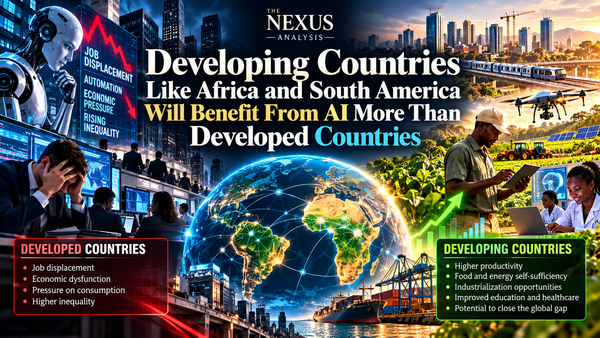
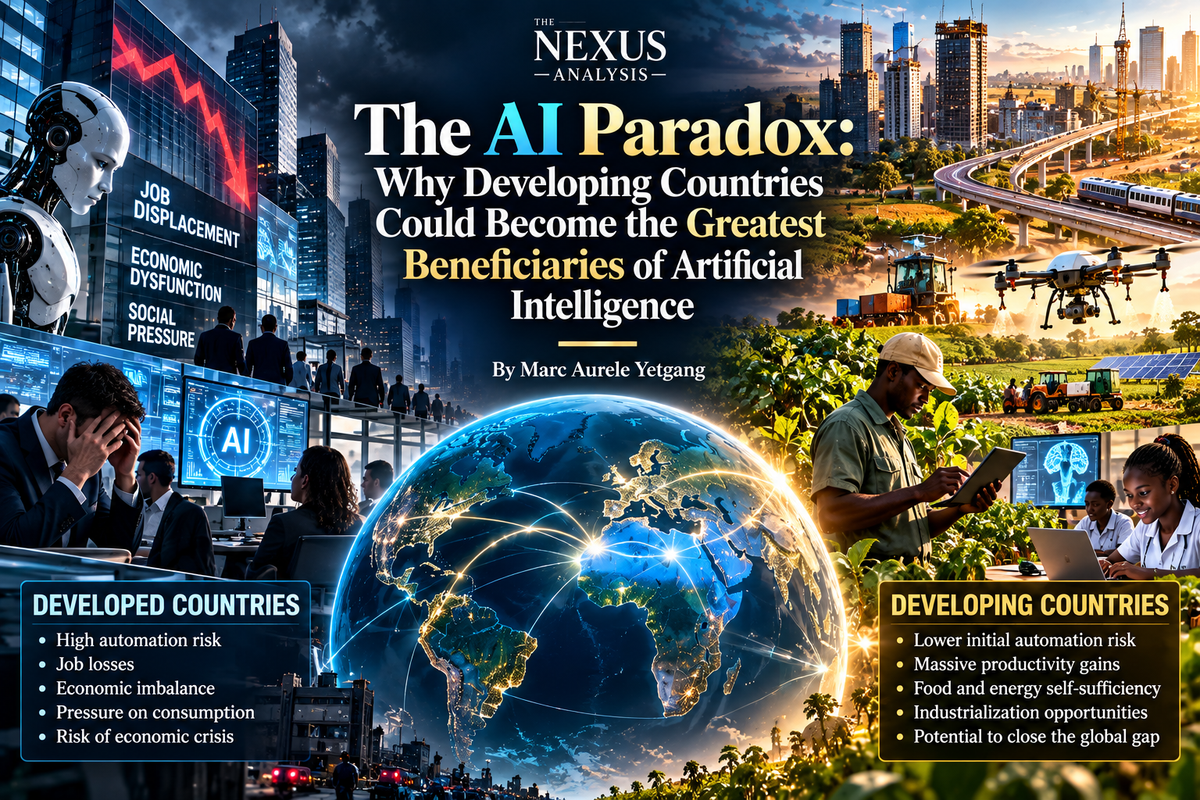
The AI Paradox: Why Developing Countries Could Become the Greatest Beneficiaries of Artificial Intelligence

By Marc Aurele Yetgang
The Nexus Analysis | Global Economy & Artificial Intelligence
Artificial intelligence, robotics, and humanoid robots are often presented as the technologies that will propel advanced economies into a new era of unprecedented productivity and economic growth. The United States, Europe, China, and other technologically advanced economies are expected to become even more productive, efficient, and competitive.
But what if the greatest economic beneficiaries of this technological revolution are not the countries that are already developed?
What if artificial intelligence creates some of its most serious economic disruptions in advanced economies while offering developing countries a historic opportunity to overcome their structural weaknesses?
This is the hypothesis I want to explore.
The AI revolution may create a paradox: the countries most capable of adopting artificial intelligence could face some of its greatest economic disruptions, while countries struggling with low productivity could use the same technology to accelerate development and narrow the global economic gap.
1. The Economic Paradox Facing Developed Countries
Developed economies have spent decades building sophisticated systems of production, employment, consumption, taxation, and redistribution.
In countries such as the United States, large portions of the population depend on employment income to sustain consumption. Businesses depend on consumers to purchase their products and services, while governments rely on taxation to finance public expenditure.
These relationships form an essential part of the modern economic system.
Now imagine an advanced economy operating close to full employment.
Artificial intelligence becomes capable of performing an increasing number of intellectual tasks, while robots and humanoid machines progressively replace workers in manufacturing, logistics, administration, retail, transportation, and other industries.
From the perspective of individual businesses, this transformation may appear highly beneficial.
Companies could produce more, operate longer, reduce labor costs, and increase productivity.
But from the perspective of the entire economy, a fundamental contradiction could emerge.
What happens when companies become capable of producing more while a growing proportion of the population loses the employment income necessary to consume that production?
This is where I believe artificial intelligence could create a major economic dysfunction.
2. The Contradiction Between Production and Consumption
The economic benefits of automation are generally evaluated through productivity.
If a company can produce twice as much with fewer resources, productivity increases. Under favorable conditions, this can improve profitability, lower prices, and contribute to economic growth.
However, productivity growth does not automatically guarantee that the resulting economic gains will be distributed across society.
Workers are not simply factors of production. They are also consumers.
Their wages finance household expenditure, which generates revenue for businesses and supports economic activity.
If AI-driven automation displaces workers faster than new employment opportunities emerge, labor income could decline for affected households.
The economy could then face a paradox:
Production capacity increases while the purchasing power of a significant portion of the population deteriorates.
This does not mean that technological unemployment will inevitably cause an economic crisis. Lower prices, new industries, rising investment, shorter working hours, and alternative forms of income distribution could offset some of these effects.
Nevertheless, if labor displacement becomes sufficiently widespread and economic institutions fail to adapt, the imbalance between production and consumption could become a serious structural problem.
An economy does not become prosperous simply because it can produce more.
It must also possess mechanisms through which the population can benefit from and consume the value being created.
3. Why Developing Countries Could Have a Different Experience
Now consider the economic situation of many developing countries, particularly in Africa.
Their central challenge is often fundamentally different.
While advanced economies may struggle with the consequences of replacing existing workers, many developing economies still struggle to generate sufficient productivity, infrastructure, industrial capacity, and formal employment.
Agricultural production remains insufficient or inefficient in many areas. Manufacturing capacity is limited. Energy infrastructure is inadequate. Transportation and logistics are expensive, and many essential goods must be imported.
Even countries with large and youthful populations can experience persistent productivity constraints.
In such economies, the immediate economic challenge is not necessarily how to replace workers who are already producing efficiently.
It is how to increase the economy's capacity to produce.
This distinction is essential.
Artificial intelligence could become a disruptive force in economies where it substitutes for established employment, while becoming a productive development force in economies where it helps overcome existing production shortages.
4. AI, Robotics, and the Historic Opportunity for Developing Countries
Imagine a developing country capable of deploying artificial intelligence and robotics to improve agricultural production, food processing, manufacturing, transportation, energy management, and infrastructure development.
Farmers could use AI-assisted systems to optimize irrigation, monitor crops, detect diseases, improve yields, and reduce waste.
Manufacturers could introduce intelligent machinery to improve production quality, reduce costs, and expand domestic industrial capacity.
Energy providers could use AI to improve electricity distribution, predict equipment failures, and manage increasingly complex power systems.
Governments could use AI to improve public administration, infrastructure planning, education, and healthcare delivery.
In these circumstances, the principal economic effect of AI could be an increase in productive capacity rather than the immediate elimination of large numbers of existing jobs.
For countries that currently import substantial quantities of food, manufactured goods, and other essential products, this transformation could be especially important.
AI and robotics could help reduce dependence on imports, strengthen domestic production, and support the emergence of new industries.
The opportunity is therefore not simply technological.
It is an opportunity for structural economic transformation.
However, achieving these benefits will require investment in reliable electricity, connectivity, infrastructure, education, financing, and technical capabilities. Artificial intelligence cannot independently compensate for every institutional or physical constraint.
5. Could AI Help Developing Countries Catch Up?
One of the most important questions in development economics concerns why some countries achieve sustained productivity growth while others remain trapped in low-income economic structures.
Technological capability, capital accumulation, human capital, institutions, infrastructure, and industrial development all contribute to this divergence.
Artificial intelligence could change parts of this equation.
Historically, developing countries have often needed substantial financial and human resources to acquire advanced productive capabilities.
AI may reduce the cost of accessing certain forms of technical knowledge, professional expertise, software development, research assistance, and operational optimization.
When combined with appropriate infrastructure and investment, intelligent machines could also increase the productive capacity of economies facing shortages of specialized labor or modern equipment.
This creates the possibility of technological catch-up.
A country may not need to reproduce every stage of industrial and technological development experienced by advanced economies before adopting some of the capabilities associated with modern production.
But the opportunity is not automatic.
Countries that remain dependent on imported AI systems, foreign cloud infrastructure, external capital, and proprietary technologies may capture only a limited share of the economic value generated.
For developing countries to become major beneficiaries, they must move beyond consuming artificial intelligence toward building the capacity to deploy, maintain, adapt, and eventually develop technologies suited to their own economic needs.
6. The Same Technology, Two Different Economic Challenges
The economic implications of AI can therefore differ according to a country's starting conditions.
In an advanced economy with high productivity and substantial formal employment, the challenge may be to prevent technological substitution from creating widespread income insecurity, excessive concentration of economic gains, and insufficient consumer demand.
In a developing economy with low productivity and substantial unmet demand, the challenge may be to use AI to increase production, improve infrastructure, reduce costs, and expand access to essential goods and services.
This leads to a distinction:
For developed countries, the central challenge could be managing the distribution of AI-generated productivity gains.
For developing countries, the central opportunity could be using AI to create productive capacity that previously did not exist.
These are not mutually exclusive outcomes. Developed countries can also benefit enormously from AI-driven innovation, while developing countries can experience job displacement, technological dependence, and inequality.
The difference lies in the economic conditions through which AI is introduced and the policies that determine who captures its benefits.
7. A New Opportunity for Africa
Africa has a particularly important opportunity in this transformation.
The continent possesses a young population, significant natural resources, expanding markets, and substantial unmet demand for infrastructure, industrial goods, energy, education, and healthcare.
But demographic potential and natural resources do not automatically translate into economic prosperity.
Productivity remains fundamental.
Artificial intelligence and robotics could help African economies address longstanding production challenges and create new paths toward industrialization.
Rather than treating AI exclusively as a technology for replacing human labor, African policymakers could approach it as an instrument for expanding productive capacity.
The strategic objective should be to use AI to produce more food, generate more energy, develop more industries, improve public services, and increase the productivity of workers and enterprises.
This would require deliberate national strategies connecting AI adoption with industrial policy, agricultural modernization, education, energy infrastructure, and domestic entrepreneurship.
The greatest opportunity may not be to imitate the automation strategies of advanced economies.
It may be to develop an AI strategy designed specifically around Africa's economic constraints and development priorities.
Conclusion: The AI Revolution Could Reshape the Global Development Gap
The rise of artificial intelligence, robotics, and humanoid machines may become one of the most consequential economic transformations of the twenty-first century.
But its effects will not be uniform.
Advanced economies could experience substantial productivity gains alongside difficult transitions in employment, income distribution, taxation, and consumption.
Developing economies could use the same technologies to overcome production constraints, strengthen domestic industries, improve essential services, and accelerate economic growth.
This leads me to a broader conclusion:
The countries that benefit most from artificial intelligence may not necessarily be those that are already the richest or most technologically advanced. They may be those that use AI most effectively to resolve their fundamental economic problems.
For developed countries, AI could create the challenge of managing abundance without undermining the purchasing power of society.
For developing countries, AI could create an opportunity to overcome scarcity by expanding productive capacity.
If developing countries recognize this opportunity and build the necessary infrastructure, institutions, skills, and technological capabilities, the AI revolution could become a powerful force for economic convergence.
The future global economic hierarchy is not predetermined.
Artificial intelligence could widen the gap between developed and developing countries—or become one of the greatest opportunities in modern history to narrow it.
The outcome will depend on the economic strategies countries adopt today.
Marc Aurele Yetgang
The Nexus Analysis